
Welcome to IQ
Welcome to Isio’s latest quarterly pensions update for sponsors, summarising key events from the quarter and looking ahead to what’s coming up.
Change in funding positions since 30 June 2026
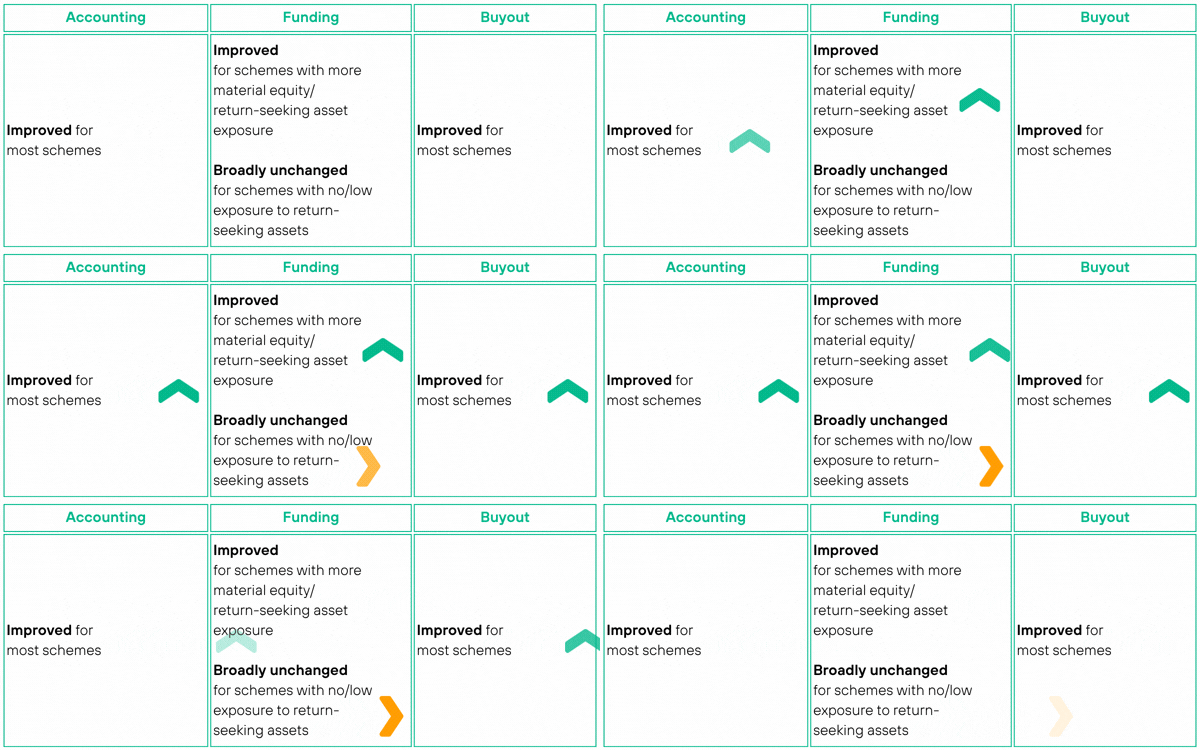
Commentary over the quarter
- The positions shown are indicative, based on example portfolios and market conditions as at 30 September 2026. Actual outcomes will vary depending on each scheme’s asset allocation, hedging and experience over the quarter.
- Gilt yields increased by c.45 bps and corporate bond yields increased by c.60 bps over the quarter.
- Inflation expectations increased by c.25 bps over the quarter.
- Credit spreads widened at all durations over the quarter.
- Global equity markets were up by c.2% over Q3 2026, supporting positions for schemes with more material return-seeking asset exposure.
- Accounting liabilities are valued using corporate bond yields, whereas funding liabilities are typically linked more closely to gilt yields. The widening of credit spreads therefore reduced accounting liabilities without an equivalent movement in gilt-hedged assets, improving accounting positions.
- Funding positions for schemes with limited return-seeking assets were broadly unchanged, as their hedging assets moved broadly in line with funding liabilities. Schemes with material equity exposure also benefited from positive market returns.
- Buyout positions also improved over the quarter. See the Future of DB section for further commentary on insurance market conditions and endgame options.
- We are hosting a webinar discussing Accounting for Pensions on Thursday 12 November. Sign up for this webinar here.
Retirement income phase takes centre stage
Background
The retirement landscape is changing fast. New requirements for occupational trust-based DC pension schemes will place greater emphasis on helping members convert their pension savings into sustainable retirement income. DC scheme trustees will be expected to provide members with a default retirement option delivering a regular income in retirement (known as ‘guided retirement’). Alongside this, schemes will also be subject to a more rigorous Value for Money assessment covering areas such as investment performance, costs, governance and service quality.
Isio’s view
We welcome this drive to improve member outcomes and increase transparency across the DC market.
Providers are increasingly focused on developing retirement income solutions to support members beyond retirement. Emerging solutions range from enhanced drawdown and hybrid approaches combining flexible access with elements of secure or guaranteed income, to Collective Defined Contribution (CDC) arrangements. The focus is shifting from accumulating savings to delivering better retirement outcomes.
Implementation of these reforms should begin by 2028 (depending on scheme size). However, the guided retirement requirements have been delayed to 2029 to allow retirement CDC to be a possible default option.
Why it matters
For employers running their own DC trust-based schemes, these changes will bring additional compliance requirements, and a greater focus on demonstrating value. Those using a master trust or bundled pension provider should understand the retirement income solutions being developed by their provider.
Retirement income propositions and default investment strategies are becoming key differentiators between providers and important drivers of member outcomes.
The future of DB schemes
Introduction
Buy-out with an insurer and run on are no longer the only endgame options for trustees and sponsors of DB schemes. With more potential destinations than ever before, there is an opportunity to select the most appropriate endgame and right timeframe for achieving it.
Insurance
Market activity remains robust, with strong transaction volumes, competitive pricing and significant insurer capacity supporting schemes considering endgame solutions. Member experience is becoming an increasingly important differentiator, e.g. administration quality.
Purposeful Run-On
Running on with gradual surplus release is an increasingly attractive option for well-funded schemes. Expected legislative reforms from April 2027 will make surplus extraction easier, benefitting sponsors through access to previously trapped value and members through benefit enhancements.
Alternative risk settlement
Alternative options to remove DB risk for sponsors are becoming increasingly common. Superfunds and sponsor transfer (where the current sponsor is replaced by a third-party asset manager) can remove schemes from a sponsor’s balance sheet quicker and at a lower funding level than buy-out, albeit through different structures and regulatory regimes.
Until recently Clara was the only superfund to have completed TPR’s assessment process (with eight transactions completed to date), while Stagecoach remains the only completed sponsor transfer transaction. These emerging solutions are expected to become increasingly mainstream and gain momentum in the months ahead.
Summary
Not all endgame options will be suitable for every scheme. The right strategy depends on a scheme’s funding position, covenant, membership profile and stakeholder objectives. Please speak to your Isio consultant who can help you quantitatively and qualitatively assess the options and implement your preferred approach.
Are pension schemes navigating with an outdated map?
Background
The pensions industry has long applied a predictable and familiar approach to derisking, using investment-grade corporate bonds as a key part of the default destination.
With credit spreads tight and endgames evolving, this may no longer be the dependable approach it once was.
Isio’s view
Traditional derisking strategies are no longer the most efficient route for many schemes. In today’s market, portfolio diversification does not necessarily deliver the level of protection that many models suggest. This is an important consideration for schemes looking to run on.
Schemes targeting insurance are often positioning themselves for a market that has evolved significantly from the one many advisers still reference.
There is growing evidence that alternative asset classes can offer stronger spreads, higher credit quality, and lower levels of underlying risk than conventional approaches. Yet many schemes continue to make strategic decisions using frameworks built for a very different market environment.
Why it matters
The challenge is not the principle of derisking. It’s ensuring that schemes are measuring risk appropriately, allocating capital efficiently, and comparing endgame options from a genuinely optimised position.
As the pensions landscape continues to evolve, the industry may need to rethink some long-standing assumptions and reassess what effective derisking looks like in practice. Click “Watch now” to hear Isio CIO, Barry Jones, explore this in more detail below.
Watch now
Looking forward to next quarter
-
Change in funding positions since 30 June 2026
Commentary over the quarter
- The positions shown are indicative, based on example portfolios and market conditions as at 30 September 2026. Actual outcomes will vary depending on each scheme’s asset allocation, hedging and experience over the quarter.
- Gilt yields increased by c.45 bps and corporate bond yields increased by c.60 bps over the quarter.
- Inflation expectations increased by c.25 bps over the quarter.
- Credit spreads widened at all durations over the quarter.
- Global equity markets were up by c.2% over Q3 2026, supporting positions for schemes with more material return-seeking asset exposure.
- Accounting liabilities are valued using corporate bond yields, whereas funding liabilities are typically linked more closely to gilt yields. The widening of credit spreads therefore reduced accounting liabilities without an equivalent movement in gilt-hedged assets, improving accounting positions.
- Funding positions for schemes with limited return-seeking assets were broadly unchanged, as their hedging assets moved broadly in line with funding liabilities. Schemes with material equity exposure also benefited from positive market returns.
- Buyout positions also improved over the quarter. See the Future of DB section for further commentary on insurance market conditions and endgame options.
- We are hosting a webinar discussing Accounting for Pensions on Thursday 12 November. Sign up for this webinar here.
-
Retirement income phase takes centre stage
Background
The retirement landscape is changing fast. New requirements for occupational trust-based DC pension schemes will place greater emphasis on helping members convert their pension savings into sustainable retirement income. DC scheme trustees will be expected to provide members with a default retirement option delivering a regular income in retirement (known as ‘guided retirement’). Alongside this, schemes will also be subject to a more rigorous Value for Money assessment covering areas such as investment performance, costs, governance and service quality.
Isio’s view
We welcome this drive to improve member outcomes and increase transparency across the DC market.
Providers are increasingly focused on developing retirement income solutions to support members beyond retirement. Emerging solutions range from enhanced drawdown and hybrid approaches combining flexible access with elements of secure or guaranteed income, to Collective Defined Contribution (CDC) arrangements. The focus is shifting from accumulating savings to delivering better retirement outcomes.
Implementation of these reforms should begin by 2028 (depending on scheme size). However, the guided retirement requirements have been delayed to 2029 to allow retirement CDC to be a possible default option.
Why it matters
For employers running their own DC trust-based schemes, these changes will bring additional compliance requirements, and a greater focus on demonstrating value. Those using a master trust or bundled pension provider should understand the retirement income solutions being developed by their provider.
Retirement income propositions and default investment strategies are becoming key differentiators between providers and important drivers of member outcomes.
-
The future of DB schemes
Introduction
Buy-out with an insurer and run on are no longer the only endgame options for trustees and sponsors of DB schemes. With more potential destinations than ever before, there is an opportunity to select the most appropriate endgame and right timeframe for achieving it.
Insurance
Market activity remains robust, with strong transaction volumes, competitive pricing and significant insurer capacity supporting schemes considering endgame solutions. Member experience is becoming an increasingly important differentiator, e.g. administration quality.
Purposeful Run-On
Running on with gradual surplus release is an increasingly attractive option for well-funded schemes. Expected legislative reforms from April 2027 will make surplus extraction easier, benefitting sponsors through access to previously trapped value and members through benefit enhancements.
Alternative risk settlement
Alternative options to remove DB risk for sponsors are becoming increasingly common. Superfunds and sponsor transfer (where the current sponsor is replaced by a third-party asset manager) can remove schemes from a sponsor’s balance sheet quicker and at a lower funding level than buy-out, albeit through different structures and regulatory regimes.
Until recently Clara was the only superfund to have completed TPR’s assessment process (with eight transactions completed to date), while Stagecoach remains the only completed sponsor transfer transaction. These emerging solutions are expected to become increasingly mainstream and gain momentum in the months ahead.
Summary
Not all endgame options will be suitable for every scheme. The right strategy depends on a scheme’s funding position, covenant, membership profile and stakeholder objectives. Please speak to your Isio consultant who can help you quantitatively and qualitatively assess the options and implement your preferred approach.
-
Are pension schemes navigating with an outdated map?
Background
The pensions industry has long applied a predictable and familiar approach to derisking, using investment-grade corporate bonds as a key part of the default destination.
With credit spreads tight and endgames evolving, this may no longer be the dependable approach it once was.
Isio’s view
Traditional derisking strategies are no longer the most efficient route for many schemes. In today’s market, portfolio diversification does not necessarily deliver the level of protection that many models suggest. This is an important consideration for schemes looking to run on.
Schemes targeting insurance are often positioning themselves for a market that has evolved significantly from the one many advisers still reference.
There is growing evidence that alternative asset classes can offer stronger spreads, higher credit quality, and lower levels of underlying risk than conventional approaches. Yet many schemes continue to make strategic decisions using frameworks built for a very different market environment.
Why it matters
The challenge is not the principle of derisking. It’s ensuring that schemes are measuring risk appropriately, allocating capital efficiently, and comparing endgame options from a genuinely optimised position.
As the pensions landscape continues to evolve, the industry may need to rethink some long-standing assumptions and reassess what effective derisking looks like in practice. Click “Watch now” to hear Isio CIO, Barry Jones, explore this in more detail below.
Watch now -
Looking forward to next quarter
Your opportunity to provide feedback on IQ
With it now being more than a year since the launch of IQ, we would appreciate a couple of minutes of your time to complete this anonymous short survey to help us ensure we maximise the value of IQ for our readers.
Join our mailing list
Get the next issue of Isio Quarterly delivered straight to your inbox