
Welcome to IQ
Welcome to Isio’s latest quarterly pensions update for sponsors, summarising key events from the quarter and looking ahead to what’s coming up.
Change in funding positions since 31 March 2026
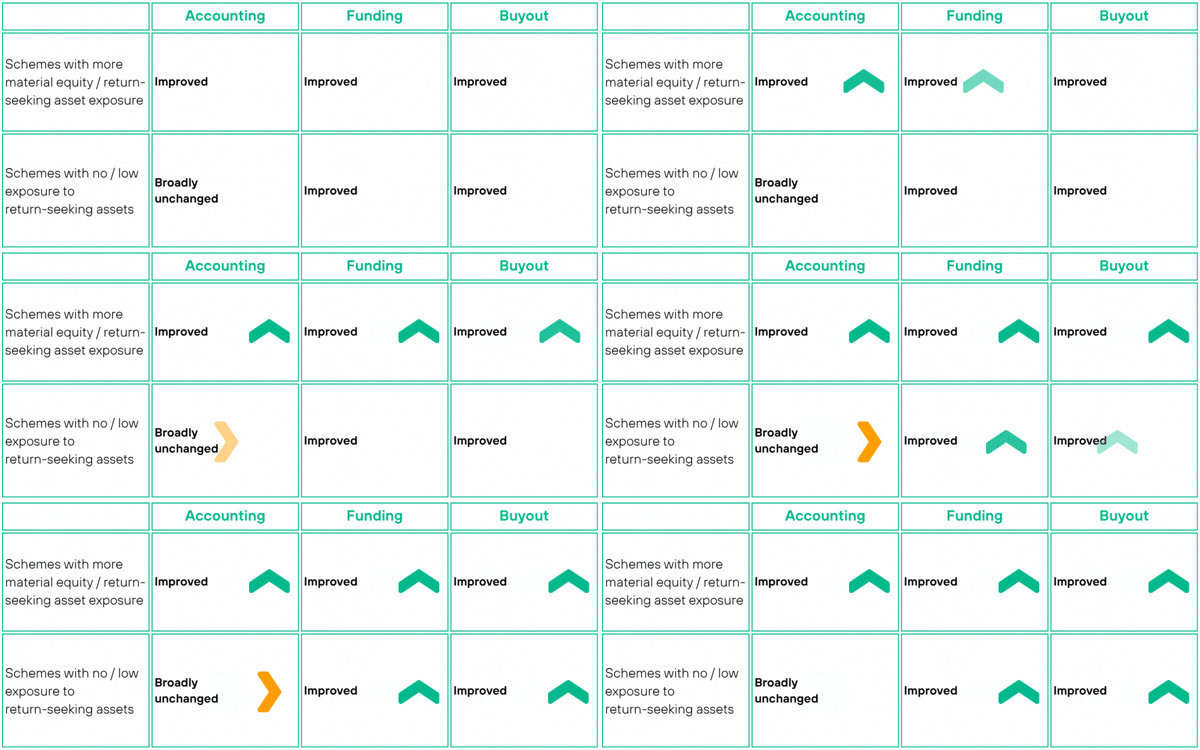
Commentary over the quarter
- The positions shown here are approximate using example portfolios based on market conditions as at 30 June 2026. There was significant volatility in the market at the beginning of this quarter which we covered in more detail in our previous issue. As a result, your scheme’s position may differ from these examples depending on your scheme’s investments and events during the quarter.
- Gilt yields fell c.5 bps while corporate bond yields fell c.20bps over the quarter.
- Inflation expectations decreased c.30 bps over the quarter.
- Credit spreads have decreased across all durations from the widening seen at the last quarter end.
- Assets were volatile at times over the quarter, but both UK and global equities ended the quarter up c.1%.
- Buy-in pricing has remained competitive over the last quarter, with lead quotations delivering attractive opportunities for schemes ready to transact. The spread between the most and least competitive quotations has widened, making effective insurer selection and competitive tension more important than ever.
Multi-employer Collective DC prepares for launch
Background
Final legislation has been passed to extend Collective Defined Contribution (Collective DC or CDC) from single employer to multi-employer arrangements.
Multi-employer Collective DC schemes will be able to apply for TPR authorisation from August 2026, with schemes expected to launch from early 2027.
Isio’s view
Most new employees in UK private sector employers are auto-enrolled into traditional ‘individual’ DC arrangements. Members bear all risks, including managing investment risk. They must make complex decisions on how to build up and use their DC pot to meet their retirement needs.
Collective DC schemes enable members to save towards a target retirement income by investing together and pooling mortality risk in retirement. As a result, Collective DC schemes are expected to provide materially higher levels of income in retirement from the same level of DC contributions.
Collective DC schemes have the potential to shift the UK pensions landscape, delivering better outcomes for employees without employers taking on risks or increased pensions spend.
Why it matters
Royal Mail launched their Collective DC scheme last year (the first in the UK) but few employers are likely to have the appetite to establish their own scheme.
However, multi-employer Collective DC schemes, operating like DC Master Trusts (i.e. no employer set up or running costs), may offer a way for mass-market adoption.
Collective DC schemes will be attractive to employers as:
- There is no impact on pension costs or accounting impact compared to current DC arrangements.
- By providing higher retirement incomes, they maximise the benefit for every £1 of pensions spend.
- They are simpler for members to understand. Benefits are shown in income terms and no complex decisions are required.
Pensions Commission interim report
Background
The Pensions Commission has published its interim report on the state of retirement saving in the UK. It estimates that 45% of working people (c.15m) are not saving enough for retirement, with low and middle earners most at risk. The report calls for a “renewed national settlement on pensions” and sets the direction for reform ahead of its final report in Spring 2027.
Potential changes include lowering the minimum auto-enrolment age from 21 to 18, encouraging longer working lives, widening eligibility and earnings coverage, increasing minimum contribution rates and supporting sidecar savings arrangements that allow limited early access to savings.
Isio’s view
We welcome a shift in focus towards retirement adequacy and delivery of sustainable retirement incomes. Higher pension savings levels are likely to be required, but implementation should be gradual. Phased contribution increases, supported by auto-escalation mechanisms, could improve outcomes while limiting cost pressures for employers.
As longer working lives and phased retirement become more widespread, appropriate workforce management will become essential to maximise the skills and experience of older workers.
We also support measures to close coverage gaps and to introduce default pathways that help members convert pension savings into sustainable retirement income. Pension policy should be considered alongside employment, housing and care policy, with greater emphasis on effective default arrangements rather than member engagement alone.
Why it matters
For employers, the report points to potentially significant changes in workforce pension provision and costs. It highlights persistent savings gaps and concerns that current incentives disproportionately benefit higher earners.
Employers should monitor developments closely, as future reforms may require changes to scheme design, workforce management, contribution structures and workforce communication strategies.
New surplus release regime becomes clearer
Background
In June, the DWP published draft regulations setting out when pension schemes will be able to release surplus. TPR simultaneously published a statement outlining its expectation that trustees should consider creating a surplus policy aligned to their long-term objective, and it will publish draft guidance later this year.
Isio’s view
This is a positive step towards the new DB surplus regime coming into force from April 2027. Whilst the minimum required funding level after surplus release is 100% on a low-dependency basis, we expect sponsors and trustees to agree a buffer above this to protect both parties – getting this buffer “just right” is important and the trade-offs are explored in this 12-minute webinar summary.
A three-month member consultation period before releasing surplus to sponsors has been proposed. This is appropriate for a one-off refund but would be clunky for regular surplus refunds paid as part of an ongoing surplus management policy.
The draft regulations also pave the way for lump sums for members over minimum pension age, taxed at a member’s marginal rate, to be paid from surplus.
Why it matters
Schemes that were waiting for regulatory clarity can now start to plan for the new regime. With over 60% of schemes overfunded on a buy-out basis, the amounts involved are material.
Negotiations on use of surplus can be emotive and require careful planning. In this context, many employers will be concerned by one of the hypothetical illustrations contained in TPR’s illustrative examples which showed a 50%-member share.
From Theory to Reality: Navigating the DB Funding Code
Background
Although the DB Funding Code has been in force for over 18 months, many schemes are only now completing their first actuarial valuations under it. As valuations conclude, sponsors are seeing the implications for funding plans, balance sheets, and long-term risk exposure.
Isio’s view
Trustees are required to define a “low dependency” investment strategy to be in place by the time the scheme reaches significant maturity. Low dependency portfolios should reduce reliance on future employer contributions. This has implications for expected return and for well-funded schemes, sponsors should assess whether the target low dependency strategy remains aligned with their endgame objectives.
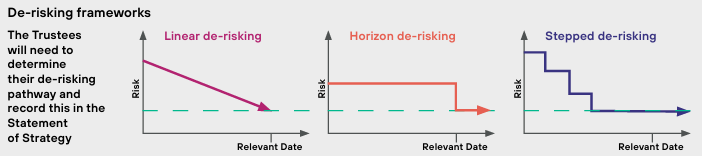
Trustees must document a clear de-risking pathway showing how the scheme’s investment strategy intends to transition over time, ideally avoiding unnecessary complexity, costs or running inappropriate levels of risk. De-risking too early may increase the likelihood of future contributions being required. De-risking too late may unnecessarily expose the scheme to volatility close to its endgame.
Lower return doesn’t automatically mean lower risk for sponsors. Excessive de-risking may reduce short-term volatility, but may limit the scheme’s ability to recover from shocks or protect against future non-investment risks. This increases the likelihood of contributions being required in adverse scenarios.
Why it matters
What should sponsors do now?
- Develop an understanding of the investment and resilience tests
- Engage early with trustees on strategy and funding impacts
- Assess the impact of different de-risking pathways on potential cash contributions
- Ensure decisions strike a balance between risk reduction and efficiency
Ultimately, sponsors should ensure that compliance with the Code doesn’t inadvertently drive decisions that increase long-term funding costs or reduce strategic flexibility.
Uncovering the most influential Professional Trustee Firms
Background
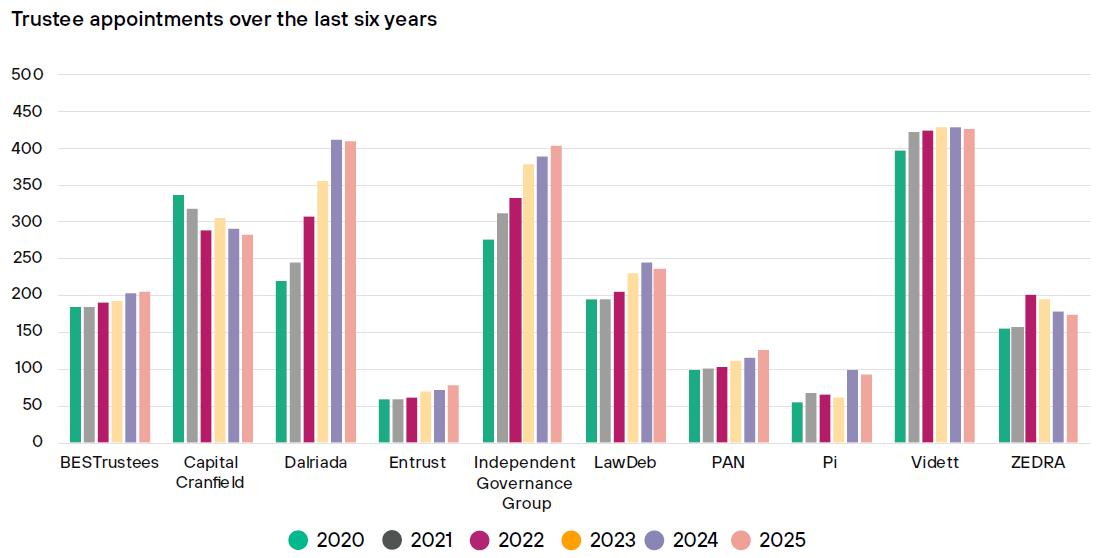
With the growing burden of pensions regulation, trustee boards are under pressure to have the right skillsets to run their schemes effectively. Sponsors and trustees are increasingly turning to Professional Trustee firms for support. Isio’s annual Independent Trustee Survey uncovers the most influential firms and is a must-read for those selecting a Professional Trustee.
Isio’s view
The independent professional trustee market continues to thrive. However, as the DB market evolves, many appointments are ending as schemes complete insurance transactions and wind-up. There is also a growing differentiation in firms, ranging from firms that focus exclusively on trusteeship to those that offer bundled models, including a range of governance and support services.
The DWP consultation on trusteeship and governance earlier this year highlighted some key areas around trustee governance and conflicts of interest. The survey summarises the views of the Professional Trustee firms in these areas.
We are expecting further guidance from the Pensions Regulator on Sole Trusteeship later this year.
Why it matters
Having skilled and experienced trustees in place can enable faster decision-making and can often ease the burden on the sponsor’s management time. In addition, the Regulator is placing increased focus on the diversity of trustee boards, which is further driving the growth in independent trustee appointments. Sponsors should consider whether their existing trustees have the right skills, capabilities and diversity to help deliver their future pensions strategy.
Watch the webinar recording
Looking forward to next quarter
- Our 2026 Isio Conference, Disrupting complacency: Shaping a better future for pensions, takes place place on 9 September in London. You can sign up for this event here.
- Andy Burnham has become the new Prime Minister. To date, he has confirmed his support of the triple lock and hasn’t publicly opposed any of the other pension policies in Labour’s manifesto. However, we are keeping a close eye on how this develops.
-
Change in funding positions since 31 March 2026
Commentary over the quarter
- The positions shown here are approximate using example portfolios based on market conditions as at 30 June 2026. There was significant volatility in the market at the beginning of this quarter which we covered in more detail in our previous issue. As a result, your scheme’s position may differ from these examples depending on your scheme’s investments and events during the quarter.
- Gilt yields fell c.5 bps while corporate bond yields fell c.20bps over the quarter.
- Inflation expectations decreased c.30 bps over the quarter.
- Credit spreads have decreased across all durations from the widening seen at the last quarter end.
- Assets were volatile at times over the quarter, but both UK and global equities ended the quarter up c.1%.
- Buy-in pricing has remained competitive over the last quarter, with lead quotations delivering attractive opportunities for schemes ready to transact. The spread between the most and least competitive quotations has widened, making effective insurer selection and competitive tension more important than ever.
-
Multi-employer Collective DC prepares for launch
Background
Final legislation has been passed to extend Collective Defined Contribution (Collective DC or CDC) from single employer to multi-employer arrangements.
Multi-employer Collective DC schemes will be able to apply for TPR authorisation from August 2026, with schemes expected to launch from early 2027.
Isio’s view
Most new employees in UK private sector employers are auto-enrolled into traditional ‘individual’ DC arrangements. Members bear all risks, including managing investment risk. They must make complex decisions on how to build up and use their DC pot to meet their retirement needs.
Collective DC schemes enable members to save towards a target retirement income by investing together and pooling mortality risk in retirement. As a result, Collective DC schemes are expected to provide materially higher levels of income in retirement from the same level of DC contributions.
Collective DC schemes have the potential to shift the UK pensions landscape, delivering better outcomes for employees without employers taking on risks or increased pensions spend.
Why it matters
Royal Mail launched their Collective DC scheme last year (the first in the UK) but few employers are likely to have the appetite to establish their own scheme.
However, multi-employer Collective DC schemes, operating like DC Master Trusts (i.e. no employer set up or running costs), may offer a way for mass-market adoption.
Collective DC schemes will be attractive to employers as:
- There is no impact on pension costs or accounting impact compared to current DC arrangements.
- By providing higher retirement incomes, they maximise the benefit for every £1 of pensions spend.
- They are simpler for members to understand. Benefits are shown in income terms and no complex decisions are required.
-
Pensions Commission interim report
Background
The Pensions Commission has published its interim report on the state of retirement saving in the UK. It estimates that 45% of working people (c.15m) are not saving enough for retirement, with low and middle earners most at risk. The report calls for a “renewed national settlement on pensions” and sets the direction for reform ahead of its final report in Spring 2027.
Potential changes include lowering the minimum auto-enrolment age from 21 to 18, encouraging longer working lives, widening eligibility and earnings coverage, increasing minimum contribution rates and supporting sidecar savings arrangements that allow limited early access to savings.
Isio’s view
We welcome a shift in focus towards retirement adequacy and delivery of sustainable retirement incomes. Higher pension savings levels are likely to be required, but implementation should be gradual. Phased contribution increases, supported by auto-escalation mechanisms, could improve outcomes while limiting cost pressures for employers.
As longer working lives and phased retirement become more widespread, appropriate workforce management will become essential to maximise the skills and experience of older workers.
We also support measures to close coverage gaps and to introduce default pathways that help members convert pension savings into sustainable retirement income. Pension policy should be considered alongside employment, housing and care policy, with greater emphasis on effective default arrangements rather than member engagement alone.
Why it matters
For employers, the report points to potentially significant changes in workforce pension provision and costs. It highlights persistent savings gaps and concerns that current incentives disproportionately benefit higher earners.
Employers should monitor developments closely, as future reforms may require changes to scheme design, workforce management, contribution structures and workforce communication strategies.
-
New surplus release regime becomes clearer
Background
In June, the DWP published draft regulations setting out when pension schemes will be able to release surplus. TPR simultaneously published a statement outlining its expectation that trustees should consider creating a surplus policy aligned to their long-term objective, and it will publish draft guidance later this year.
Isio’s view
This is a positive step towards the new DB surplus regime coming into force from April 2027. Whilst the minimum required funding level after surplus release is 100% on a low-dependency basis, we expect sponsors and trustees to agree a buffer above this to protect both parties – getting this buffer “just right” is important and the trade-offs are explored in this 12-minute webinar summary.
A three-month member consultation period before releasing surplus to sponsors has been proposed. This is appropriate for a one-off refund but would be clunky for regular surplus refunds paid as part of an ongoing surplus management policy.
The draft regulations also pave the way for lump sums for members over minimum pension age, taxed at a member’s marginal rate, to be paid from surplus.
Why it matters
Schemes that were waiting for regulatory clarity can now start to plan for the new regime. With over 60% of schemes overfunded on a buy-out basis, the amounts involved are material.
Negotiations on use of surplus can be emotive and require careful planning. In this context, many employers will be concerned by one of the hypothetical illustrations contained in TPR’s illustrative examples which showed a 50%-member share.
-
From Theory to Reality: Navigating the DB Funding Code
Background
Although the DB Funding Code has been in force for over 18 months, many schemes are only now completing their first actuarial valuations under it. As valuations conclude, sponsors are seeing the implications for funding plans, balance sheets, and long-term risk exposure.
Isio’s view
Trustees are required to define a “low dependency” investment strategy to be in place by the time the scheme reaches significant maturity. Low dependency portfolios should reduce reliance on future employer contributions. This has implications for expected return and for well-funded schemes, sponsors should assess whether the target low dependency strategy remains aligned with their endgame objectives.
Trustees must document a clear de-risking pathway showing how the scheme’s investment strategy intends to transition over time, ideally avoiding unnecessary complexity, costs or running inappropriate levels of risk. De-risking too early may increase the likelihood of future contributions being required. De-risking too late may unnecessarily expose the scheme to volatility close to its endgame.
Lower return doesn’t automatically mean lower risk for sponsors. Excessive de-risking may reduce short-term volatility, but may limit the scheme’s ability to recover from shocks or protect against future non-investment risks. This increases the likelihood of contributions being required in adverse scenarios.
Why it matters
What should sponsors do now?
- Develop an understanding of the investment and resilience tests
- Engage early with trustees on strategy and funding impacts
- Assess the impact of different de-risking pathways on potential cash contributions
- Ensure decisions strike a balance between risk reduction and efficiency
Ultimately, sponsors should ensure that compliance with the Code doesn’t inadvertently drive decisions that increase long-term funding costs or reduce strategic flexibility.
-
Uncovering the most influential Professional Trustee Firms
Background
With the growing burden of pensions regulation, trustee boards are under pressure to have the right skillsets to run their schemes effectively. Sponsors and trustees are increasingly turning to Professional Trustee firms for support. Isio’s annual Independent Trustee Survey uncovers the most influential firms and is a must-read for those selecting a Professional Trustee.Isio’s view
The independent professional trustee market continues to thrive. However, as the DB market evolves, many appointments are ending as schemes complete insurance transactions and wind-up. There is also a growing differentiation in firms, ranging from firms that focus exclusively on trusteeship to those that offer bundled models, including a range of governance and support services.
The DWP consultation on trusteeship and governance earlier this year highlighted some key areas around trustee governance and conflicts of interest. The survey summarises the views of the Professional Trustee firms in these areas.
We are expecting further guidance from the Pensions Regulator on Sole Trusteeship later this year.
Why it matters
Having skilled and experienced trustees in place can enable faster decision-making and can often ease the burden on the sponsor’s management time. In addition, the Regulator is placing increased focus on the diversity of trustee boards, which is further driving the growth in independent trustee appointments. Sponsors should consider whether their existing trustees have the right skills, capabilities and diversity to help deliver their future pensions strategy.
Watch the webinar recording -
Looking forward to next quarter
- Our 2026 Isio Conference, Disrupting complacency: Shaping a better future for pensions, takes place place on 9 September in London. You can sign up for this event here.
- Andy Burnham has become the new Prime Minister. To date, he has confirmed his support of the triple lock and hasn’t publicly opposed any of the other pension policies in Labour’s manifesto. However, we are keeping a close eye on how this develops.
Your opportunity to provide feedback on IQ
With it now being more than a year since the launch of IQ, we would appreciate a couple of minutes of your time to complete this anonymous short survey to help us ensure we maximise the value of IQ for our readers.
Join our mailing list
Get the next issue of Isio Quarterly delivered straight to your inbox